
Our Occupational Therapy Framework – “The PEOP model recognises that optimal participation occurs when the person, their environment, and meaningful occupations are aligned.”
Our occupational therapy services are guided by the Person–Environment–Occupation–Performance (PEOP) model (Christiansen & Baum).
The model is an evidence-based framework that recognises participation as the outcome of the dynamic interaction between individuals, their environments, and meaningful occupations.
We work collaboratively to identify strengths, reduce barriers, and implement practical strategies that enhance functional performance, independence, and quality of life. Our approach is person-centred, strengths-based, and aligned with NDIS principles, supporting individuals to engage fully in everyday activities that matter to them.
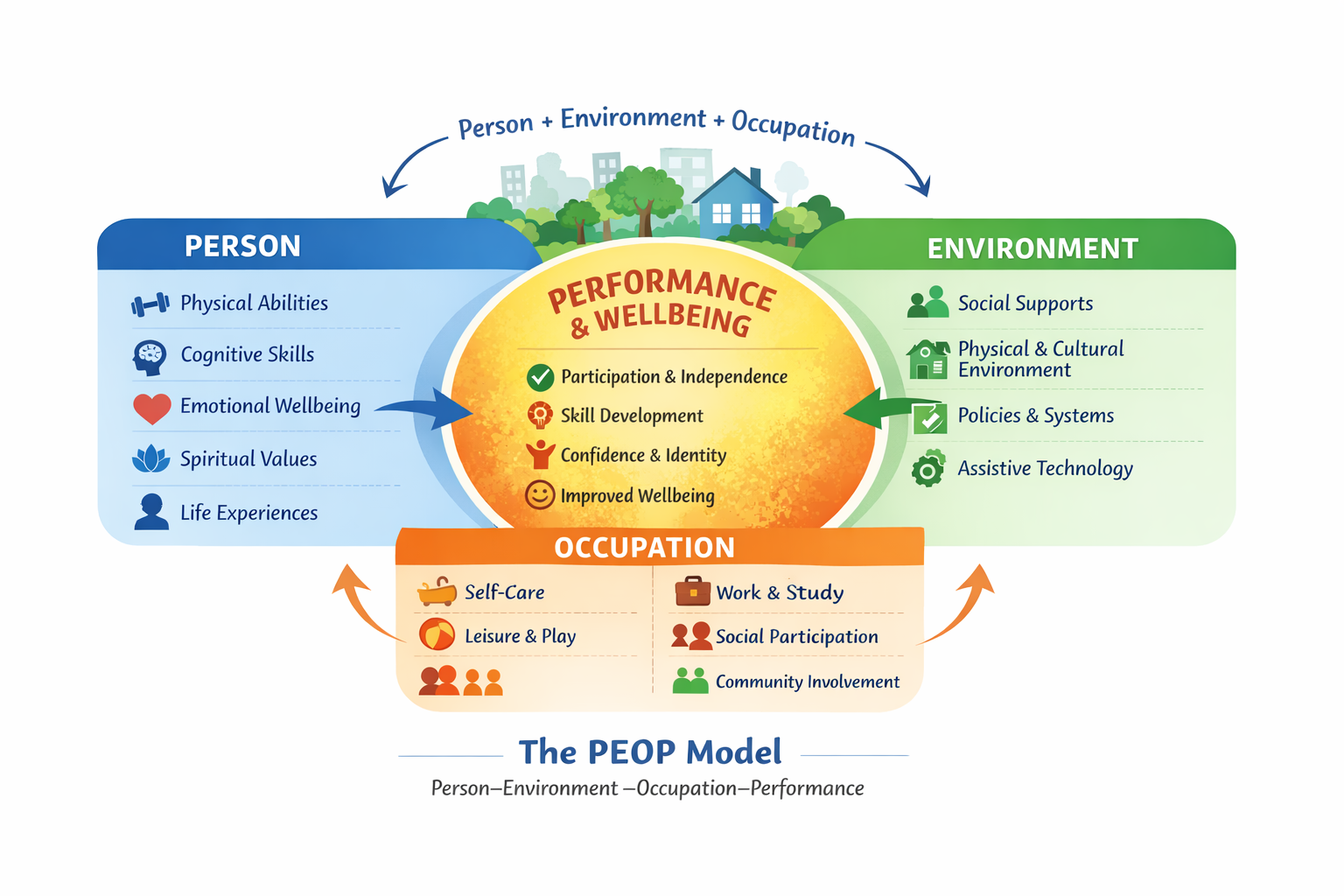
Framework Overview
The PEOP model guides our occupational therapy practice by focusing on how people engage in meaningful activities within their everyday environments.
1. Person
We consider physical, cognitive, emotional, sensory, and psychosocial strengths and challenges, as well as values, goals, and lived experience.
2. Environment
We assess physical, social, cultural, institutional, and policy environments that support or limit participation (e.g. home setup, support networks, community access).
3. Occupation
We focus on meaningful daily activities such as self-care, productivity, leisure, community participation, and roles across the lifespan.
4. Performance & Participation
Intervention aims to enhance functional performance, independence, safety, and participation in everyday life.
How does this framework support our OT Practice
- Person-centred and goal-driven
- Evidence-based and strengths-focused
- Functional and participation-oriented
- Responsive to environmental and systemic barriers
- Aligned with NDIS functional domains
To complement the PEOP model, our practice integrates:
Model of Human Occupation (MOHO)
- Focuses on motivation (volition), habits/routines (habituation), and skills, supporting sustainable engagement in daily life.
- Trauma-Informed & Neurodiversity-Affirming Practice – Ensures safety, choice, collaboration, and respect for individual differences, particularly for people with disability and complex needs.
- Occupational Adaptation – Supports individuals to adapt tasks, environments, or strategies to improve participation and role competence.